
Our services
Medical care (SGB V)
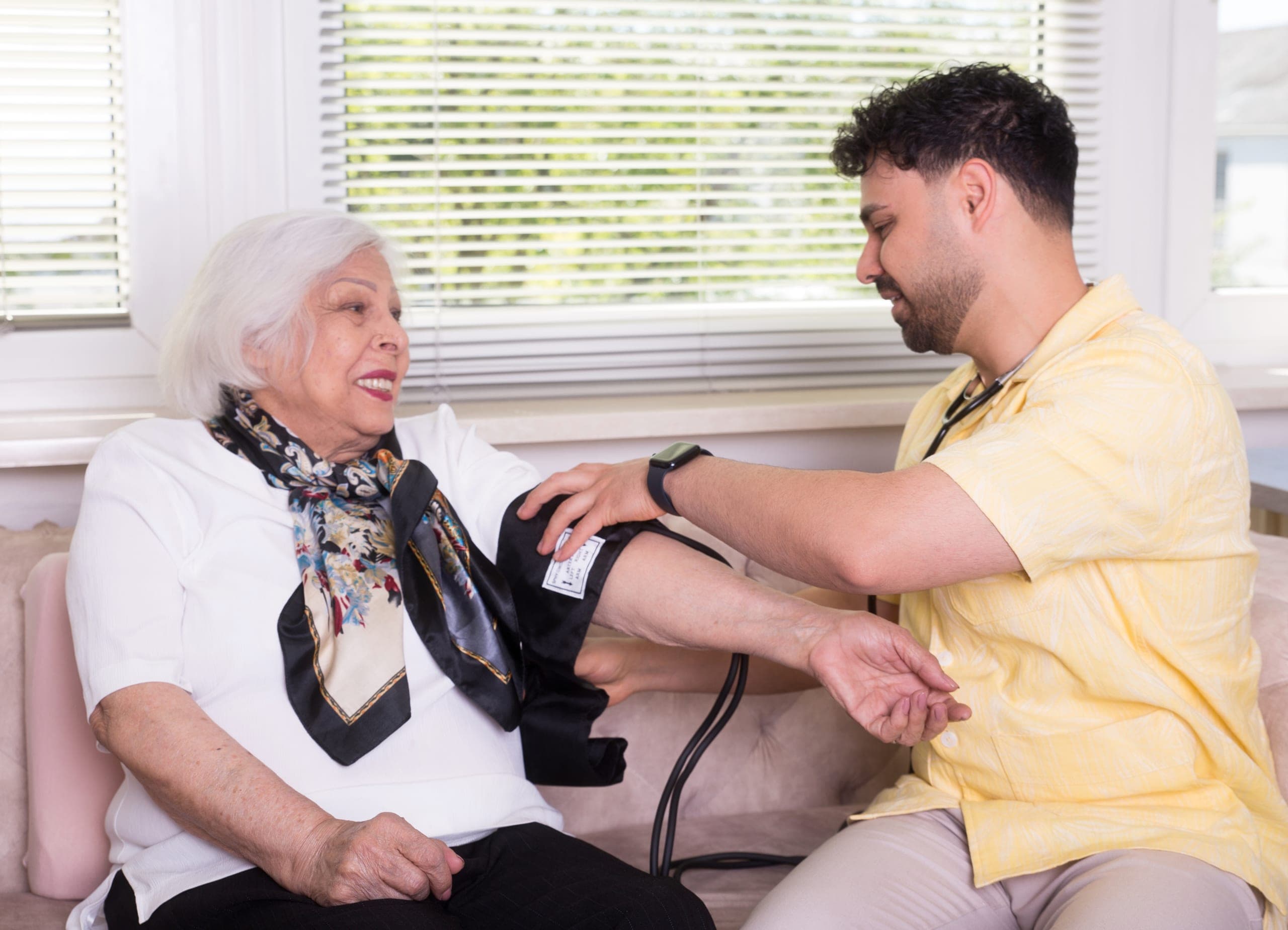
Medication administration, injections, blood pressure and blood sugar checks, wound and compression care, as prescribed by a physician.
Who is this for?
Skilled nursing care is for people who need medical services at home: after surgery or a hospital stay, with chronic wounds, with diabetes, or when daily medication needs to be given reliably. It always rests on a doctor's prescription; the clinical work itself is carried out by our registered nurses, in close coordination with your doctor's practice. For family members, this brings real relief as well: responsibility for injections, medication and dressing changes lies with professionals who are trained for exactly that.
What we take care of
Medication management we prepare, administer and document your medication according to the doctor's plan. That greatly reduces the risk of everyday mix-ups, and family members can breathe a little easier.
Injections insulin or anti-thrombosis injections, for example, given correctly and reliably at the prescribed time.
Blood pressure and blood sugar checks taken regularly, carefully documented, and discussed with the practice whenever a reading stands out.
Wound care and dressing changes carried out to the doctor's specifications, with progress documented throughout. Chronic wounds need continuity, not a different pair of hands every time.
Compression therapy putting compression stockings on and taking them off, correctly fitted, every day.
Coordination with your treatment team when something changes, we speak with your GP practice and specialist practices so that treatment at home and treatment in the practice stay aligned.
Documentation we keep a clear, traceable record of every intervention. Your doctor's practice can review the care documentation within the usual regulated framework, and family members can do so with the consent of the person receiving care; that keeps the course of care transparent for everyone involved.
Guidance for families on request, we show family members individual techniques, such as handling compression stockings, so that daily life between our visits becomes easier.
How it works
Prescription & first conversation
Your practice issues the prescription; meanwhile we answer your questions in a free initial conversation and plan what comes next.
Home visit
We get to know you and your home, and agree how the care fits into your day.
Care begins
We take over the prescribed tasks: dependably, with fixed points of contact.
The route to us runs through the doctor's prescription: your practice prescribes home nursing care, often as early as hospital discharge. We check the prescription, sort out the approval with the health insurance fund and coordinate the start date so that no gap in care opens up. In the first visit at your home we walk through the prescribed measures together, so you know what happens and when; we also remind you in good time when a follow-up prescription is due. Good to know: the start requires the doctor's prescription; once it is there, we help make sure things move quickly.
What helps at the start: the prescription itself, your health insurance card, the medication plan and, if available, the hospital discharge letter. Together these give us the complete picture: what has been prescribed, what the hospital recommends and what to watch for day to day. If your practice changes the medication, simply let us know; we reconcile the plan so that neither double doses nor gaps can occur.
Here too, the limits belong on the table: we carry out what the doctor has prescribed, and we replace neither diagnosis nor treatment decisions. Anything beyond the prescription is discussed with you and the practice before anything changes. Skilled nursing care is the responsibility of the health insurance fund under SGB V; no care grade is required, though one can exist in parallel if personal care also runs through the long-term care insurance. Whether a statutory co-payment applies depends on the individual case; your health insurance fund can tell you bindingly.
Common questions about this service
Do I need a care grade for skilled nursing care?
No. Skilled nursing care requires a doctor's prescription, not a care grade. The two can go hand in hand, though: many of our patients receive personal care through the care fund and skilled nursing care through the health insurance fund in the same visit.
Who issues the prescription?
Your GP practice or the treating specialist practice, often as early as hospital discharge. If you are unsure how to obtain the prescription, we will help you through the process.
What happens if the health insurance fund has not yet approved the care?
Your care should not fall through over paperwork. Together with you and the practice, we clarify how approval works in your case and what applies in the meantime; binding information comes from your health insurance fund.
Do you also care for chronic wounds?
Yes, following the doctor's specifications and with progress documented throughout. For complex wound types, we work together with your treatment team so that the care remains clinically sound.
Can skilled nursing care be combined with personal care?
Yes, the two combine well: a single morning visit can combine washing, dressing and medication. For you, that means fewer appointments and familiar faces.
Related guide articles
Your next step
Advice on this service
Call us as soon as a doctor's prescription is being discussed: with no obligation and no rush, we will clarify how we take over the care, how the visits run, and how billing with the health insurance fund works.
Or call us directly: 040 302 389 46